What is Multimodal GEO?
Quick Answer: Multimodal Generative Engine Optimization is strategic content optimization for AI search engines that process and generate responses across multiple formats - text, images, video, audio, and voice.
Unlike traditional GEO that focuses primarily on textual content, multimodal GEO responds to the evolution of AI search engines that can now:
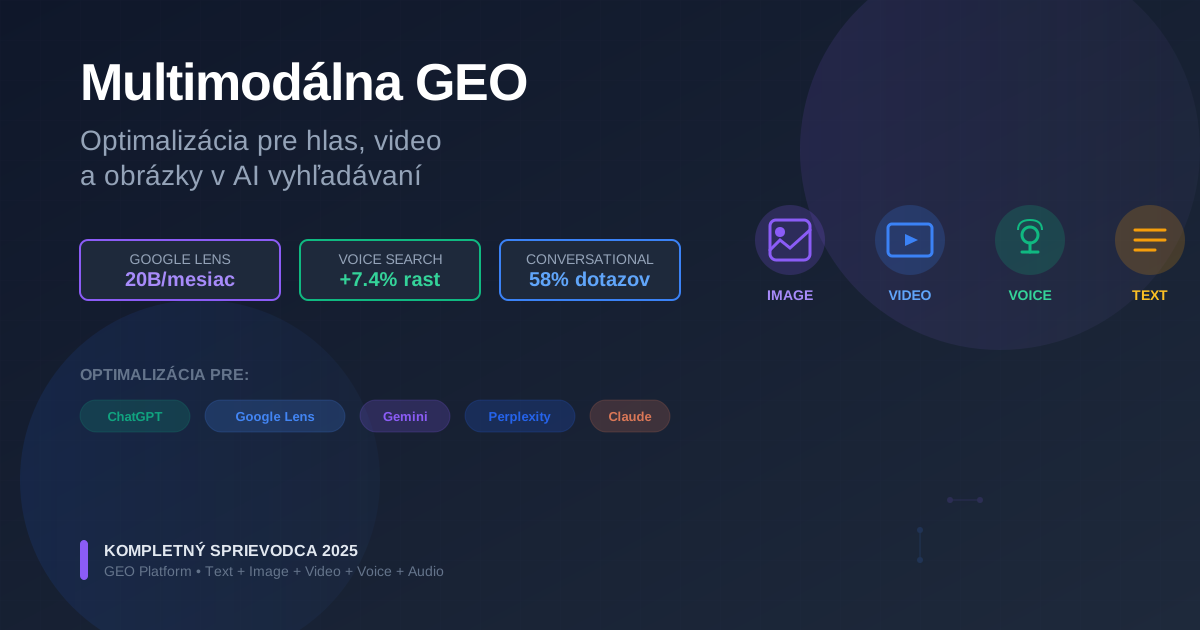
- Understand visual content (Google Lens: 20 billion searches monthly)
- Respond via voice (35% of Americans own smart speakers, +7.4% growth 2022-2024)
- Analyze video content (YouTube integration in Gemini)
- Process audio (podcasts, voice notes)
Why Multimodal GEO is Critical in 2025
The Search Revolution
The search landscape has changed dramatically in the last 12 months:
Key Statistics 2025:
- 58% of queries are now conversational (Omnius GEO Report)
- 20 billion visual searches monthly via Google Lens (Writesonic GEO Trends)
- 35% of Americans own smart speakers (WebProNews 2025 SEO Evolution)
- AI search traffic converts 4.4x better than traditional organic search, measured across 500+ digital-marketing topics (Semrush, AI search and SEO traffic study, 2025)
- Semrush projection: for digital-marketing topics, AI search starts driving more visits than traditional search by early 2028 (Semrush, AI search and SEO traffic study, 2025)
"Generative engines are becoming increasingly multimodal, able to process and provide responses across text, images, videos, and audio using Retrieval-Augmented Generation (RAG) and multimodal embeddings."
- Omnius GEO Industry Report 2025
Platform Shift: From Browser to AI
Apple's Safari Integration (Q4 2024): Apple announced that AI-native search engines like Perplexity and Claude will be built directly into Safari. This means millions of users will default to using multimodal AI search engines instead of Google.
Google's Response:
- AI Overviews (multimodal snippets)
- Google Lens expansion (visual search everywhere)
- Gemini Live (voice conversation with AI)
OpenAI SearchGPT: ChatGPT Search (launched December 2024) combines:
- Real-time web data
- Multimodal understanding (text + images)
- Conversational results (not just links)
4 Pillars of Multimodal GEO
1. Visual Optimization (Image & Video)
Google Lens Dominance
With 20 billion visual searches monthly, Google Lens is the world's largest visual search platform.
Key Use Cases:
- Product search: "Where can I buy these shoes?"
- Object identification: "What plant is this?"
- Text extraction: Scanning QR codes, menus, business cards
- Visual shopping: Finding similar products
Optimization Techniques:
A. ImageObject Schema Markup
{
  "@context": "https://schema.org",
  "@type": "ImageObject",
  "contentUrl": "https://example.com/products/red-shoes.jpg",
  "creator": {
    "@type": "Person",
    "name": "Product Photography Team"
  },
  "creditText": "BeRelevant",
  "copyrightNotice": "© 2025 BeRelevant",
  "description": "Red running shoes with breathable mesh fabric and ergonomic sole",
  "name": "Premium Running Shoes - Red Edition"
}
B. Alt Text Optimization
❌ Bad practice:
<img src="img1234.jpg" alt="shoes">✅ Good practice:
<img
  src="red-running-shoes-nike.jpg"
  alt="Red Nike running shoes with breathable mesh fabric, side view on white background"
  title="Nike Air Zoom Pegasus 40 - Red"
  width="1200"
  height="800"
>
C. File Naming Conventions
- ❌
IMG_1234.jpg,photo.png,image-final-v2.jpg - ✅
product-red-running-shoes-nike-air-zoom.jpg
D. Image Quality Requirements
| Platform | Min. width | Recommended format | Compression |
|---|---|---|---|
| Google Lens | 1200px | WebP, JPEG | 85% quality |
| ChatGPT | 800px | JPEG, PNG | 90% quality |
| Gemini | 1024px | WebP | 80% quality |
Video Optimization
VideoObject Schema Markup:
{
  "@context": "https://schema.org",
  "@type": "VideoObject",
  "name": "How to Optimize for GEO - Complete Tutorial",
  "description": "15-minute guide to optimizing content for AI search engines",
  "thumbnailUrl": "https://example.com/video-thumbnail.jpg",
  "uploadDate": "2025-01-20T08:00:00+00:00",
  "duration": "PT15M33S",
  "contentUrl": "https://example.com/videos/geo-tutorial.mp4",
  "embedUrl": "https://youtube.com/embed/VIDEO_ID",
  "publisher": {
    "@type": "Organization",
    "name": "BeRelevant",
    "logo": {
      "@type": "ImageObject",
      "url": "https://berelevant.now/logo.svg"
    }
  }
}
YouTube + Gemini Integration:
Gemini directly integrates YouTube results into AI responses. Optimizing YouTube videos for Gemini:
✅ Video title optimization:
- Start with key phrase ("How to optimize for GEO")
- Add year for freshness ("2025 Guide")
- Keep under 60 characters
✅ Description best practices:
- First 150 characters are critical (appears in snippets)
- Include timestamps (0:00 Intro, 2:15 Chapter 1, etc.)
- Link to related content (blog posts, resources)
✅ Closed captions (CC):
- Upload custom captions (not auto-generated)
- AI uses captions to understand content
- Add keywords naturally into dialogue
2. Voice Optimization (Voice Search)
Voice Search Growth
2025 Statistics:
- 7.4% increase in smart speaker usage 2022-2024
- 58% of queries are conversational
- 35% of households in USA have smart speakers
AI Platforms with Voice:
- ChatGPT Voice Mode (iOS, Android)
- Gemini Live (conversational AI)
- Perplexity Voice (hands-free search)
- Alexa, Google Assistant, Siri (traditional, but evolving with AI)
Voice Search Optimization Techniques
A. Conversational Key Phrases
Voice queries are longer and more natural than text:
| Text Query | Voice Query |
|---|---|
| "GEO optimization guide" | "How can I optimize my website for AI search engines in 2025?" |
| "best running shoes" | "What are the best running shoes for flat feet under 100 euros?" |
| "ChatGPT ranking factors" | "How can I improve my ranking in ChatGPT search results?" |
Optimize for question-based queries:
- Who: "Who are the best GEO experts?"
- What: "What is multimodal GEO optimization?"
- Where: "Where can I find GEO audit tools?"
- When: "When should I update my content for AI?"
- Why: "Why is GEO important for B2B SaaS?"
- How: "How to optimize images for Google Lens?"
B. FAQ Schema Markup
FAQPage schema is critical for voice assistants:
{
  "@context": "https://schema.org",
  "@type": "FAQPage",
  "mainEntity": [
    {
      "@type": "Question",
      "name": "What is multimodal GEO?",
      "acceptedAnswer": {
        "@type": "Answer",
        "text": "Multimodal GEO is content optimization for AI search engines that process text, images, video, audio, and voice. It includes optimization for Google Lens (20 billion searches monthly), voice assistants, and AI platforms like ChatGPT Search."
      }
    }
  ]
}
C. SpeakableSpecification
Mark content suitable for voice assistants to read:
{
  "@context": "https://schema.org",
  "@type": "Article",
  "speakable": {
    "@type": "SpeakableSpecification",
    "cssSelector": [".article-summary", ".key-takeaways"]
  }
}
D. Answer Capsule Format for Voice
Voice assistants prefer short, direct answers (20-30 words):
## What is GEO?

**Voice Answer:** GEO is content optimization for AI search engines like ChatGPT,
Perplexity, and Gemini that generate answers instead of displaying links.

[More detailed explanation follows for text readers...]
3. Audio Optimization (Podcasts, Audio Content)
Podcast Boom in AI Era
Why Audio Matters:
- Gemini can analyze audio files
- ChatGPT (planned audio understanding)
- Perplexity indexes podcast transcriptions
- YouTube Music + Gemini integration
AudioObject Schema Markup:
{
  "@context": "https://schema.org",
  "@type": "AudioObject",
  "name": "BeRelevant Podcast Ep. 15: Multimodal Optimization",
  "description": "Discussion about optimizing visual and audio content for AI",
  "duration": "PT42M15S",
  "encodingFormat": "audio/mpeg",
  "contentUrl": "https://example.com/podcasts/ep15.mp3",
  "uploadDate": "2025-01-20"
}
Podcast Optimization Techniques:
✅ Create transcriptions:
- Complete, accuracy > 95%
- Add timestamps
- Edit for readability (remove "um", "eh")
✅ Show notes optimization:
- Episode summary (150-200 words)
- Key topics with timestamps
- Links to mentioned resources
- Guest bio + links
✅ Audio quality:
- Min. 128 kbps bitrate
- Clear voice, minimal background noise
- Professional intro/outro
4. SearchGPT & ChatGPT Search Optimization
The New King: ChatGPT Search
Launched December 2024, ChatGPT Search (SearchGPT) represents the biggest threat to Google Search since 1998.
Key Differences vs. Google:
| Aspect | Google Search | ChatGPT Search |
|---|---|---|
| Results Format | 10 blue links | Conversational answer with citations |
| Data | Web index | Real-time web + GPT knowledge |
| Multimodal | Partial (Lens) | Text + images (video soon) |
| Personalization | Cookies, history | Conversational context |
| Citations | Meta descriptions | Inline citations with links |
Top 11 SearchGPT Ranking Factors
According to Rock The Rankings research and Go Fish Digital study:
1. Domain Authority & Trust (High weight)
SearchGPT prioritizes authoritative domains:
- Trusted sources: .edu, .gov, reputable news sites
- Brand recognition: Known brands have higher citation chance
- Consistent citations: Domains cited by other authoritative sources
2. Content Freshness (Critical)
OpenAI's SearchGPT prototype explicitly uses "real-time web data":
- Update evergreen content every 3 months
- Add "Last Updated: [DATE]" at article start
- Publish news-jacking content (real-time trends)
3. Conversational & Intent Optimization (High)
AI search excels at understanding user intent:
- Analyze queries in full conversational context
- Optimize for natural language (not keyword stuffing)
- Answer intent (informational / transactional / navigational)
4. Structured Data (Medium-High)
Structured data helps AI quickly understand and display information:
- Article schema (title, author, datePublished, dateModified)
- FAQPage schema (for Q&A content)
- HowTo schema (step-by-step guides)
- Organization schema (brand info)
5. Content Quality & Clarity (High)
ChatGPT ranks content that is:
- Well-structured: Clear headings (H2 → H3)
- Easy to parse: Bullet points, short paragraphs
- Rich in verified info: Citations, statistics, data
6. Technical SEO (Medium)
Bing (and thus ChatGPT Search) uses page performance as quality signal:
- Core Web Vitals: LCP < 2.5s, FID < 100ms, CLS < 0.1
- Mobile-friendly: Responsive design
- HTTPS: Secure connection
- Crawlability: Allow GPTBot in robots.txt
7. Awards & Recognition (Medium)
Strong correlation between "Best of" awards and SearchGPT rankings:
- Consumer queries: Popular awards (G2, Capterra)
- B2B queries: Industry awards (Gartner, Forrester)
- Example: "Best CRM for small business" → Products with awards dominate
8. E-E-A-T Signals (High)
Experience, Expertise, Authoritativeness, Trustworthiness:
- Author credentials: "Dr. John Doe, PhD in Computer Science"
- Author bio: LinkedIn profile, publications
- Expert quotes: Citations from industry leaders
- Editorial policy: Fact-checking disclosure
9. Backlink Profile (Medium)
Backlinks still matter, but differently:
- Relevance > Quantity: 10 .edu backlinks > 1000 low-quality
- Co-citations: Mentions alongside authorities
- Link context: What text around link says
10. User Engagement Signals (Low-Medium)
Likely monitored via Bing data:
- Click-through rate (CTR) from SearchGPT results
- Dwell time on page
- Return visits
11. Allow GPTBot Crawler (Critical)
If you block GPTBot, you won't be in ChatGPT Search:
# robots.txt
User-agent: GPTBot
Allow: /

# Or specifically allow key pages
User-agent: GPTBot
Allow: /blog/
Allow: /resources/
Disallow: /admin/
Implementation Plan: 30-Day Roadmap
Week 1: Audit and Prioritization
Day 1-3: Multimodal Content Audit
Analyze your content across formats:
| Format | Asset count | % optimized | Priority |
|---|---|---|---|
| Blog articles (text) | 120 | 60% | High |
| Images (products, screenshots) | 450 | 15% | Critical |
| Videos (tutorials, demos) | 25 | 40% | Medium |
| Podcasts / Audio | 12 | 0% | Low |
Day 4-5: Platform Priority
Identify where your target audience is:
B2B SaaS (example):
- ChatGPT Search (62% AI search traffic)
- Perplexity (28%)
- Google Lens (product discovery)
- Gemini Live (voice queries)
E-commerce (example):
- Google Lens (visual search dominance)
- Perplexity (product research)
- ChatGPT Search (buying guides)
- Voice assistants (quick purchases)
Day 6-7: Competitive Analysis
Test multimodal queries:
Text: "best [your product category] for [use case]"
Voice: "Alexa, what are the best [product] for [use case]?"
Visual: Upload competitor product image to Google Lens
Video: Search for tutorials in Gemini with YouTube
Week 2: Visual Optimization
Day 8-10: Image Optimization
Prioritize top 50 images (products, featured images):
- Rename files:
product-category-description-brand.jpg - Optimize alt text: Descriptive, 10-15 words with context
- Add captions: Under each image
- Implement ImageObject schema
Day 11-12: Video Optimization
For top 10 videos:
- YouTube optimization:
- Title: Keyword-first, < 60 chars, include year
- Description: Detailed, 200+ words, timestamps
- Tags: 10-15 relevant tags
- Add VideoObject schema on landing pages
- Upload captions (custom, not auto)
Day 13-14: Visual Content Creation
Create new visual content:
- Infographics for complex topics
- Product comparison charts
- Step-by-step visual guides (HowTo schema)
Week 3: Voice and Audio Optimization
Day 15-17: Voice Search Optimization
-
FAQ content refresh:
- Identify top 20 question-based queries
- Create FAQ sections with FAQPage schema
- Optimize for 20-30 word voice answers
-
Conversational content audit:
- Reformulate headlines as questions
- Add natural language variants
Day 18-19: Podcast / Audio
If you have podcasts or audio content:
- Create transcriptions (use Otter.ai, Rev.com)
- Add AudioObject schema
- Publish show notes with timestamps
If you don't have audio:
- Consider podcast launch (voice content is underutilized)
- Or create audio summaries of top articles
Day 20-21: SpeakableSpecification
Implement on top 20 articles:
<div class="speakable-summary">
  <p><strong>Quick Answer:</strong> [20-30 word direct answer for voice assistants]</p>
</div>
Week 4: SearchGPT Optimization + Monitoring
Day 22-24: SearchGPT Technical Setup
- Allow GPTBot crawler:
# robots.txt
User-agent: GPTBot
Allow: /-
Core Web Vitals audit (SearchGPT uses Bing signals):
- Test on PageSpeed Insights
- Optimize LCP (Largest Contentful Paint)
- Minimize CLS (Cumulative Layout Shift)
-
Structured data validation:
- Google Rich Results Test
- Fix all errors and warnings
Day 25-27: Content Freshness Protocol
Establish regular update process:
-
Quarterly content refresh (every 3 months):
- Update statistics
- Add new case studies
- Refresh date: "Last Updated: [DATE]"
-
Monthly news-jacking:
- Publish 1-2 articles on current trends
- Goal: real-time relevance for SearchGPT
Day 28-30: Monitoring Setup
Multimodal Tracking Metrics:
| Metric | Tool | Frequency |
|---|---|---|
| Text citations (ChatGPT, Perplexity) | BeRelevant | Weekly |
| Visual search impressions (Google Lens) | Google Search Console | Weekly |
| Voice query rankings | Manual testing (Alexa, Siri) | Monthly |
| Video views from Gemini | YouTube Analytics (traffic source) | Weekly |
| Audio engagement (podcasts) | Podcast analytics platform | Weekly |
Manual Testing Protocol:
Test weekly:
- 5 text queries in ChatGPT Search, Perplexity, Gemini
- 3 voice queries via Alexa, Google Assistant, Siri
- 2 visual queries (upload images to Google Lens)
- 2 video queries in Gemini (with YouTube)
Tools for Multimodal GEO
Visual Optimization Tools
| Tool | Purpose | Price |
|---|---|---|
| TinyPNG / Squoosh | Image compression | Free |
| Canva | Infographic creation | $0-12.99/mo |
| Adobe Express | Professional graphics | $9.99/mo |
| Schema.org Generator | ImageObject schema | Free |
Voice Search Tools
| Tool | Purpose | Price |
|---|---|---|
| AnswerThePublic | Question-based queries | $0-99/mo |
| AlsoAsked | "People also ask" insights | $0-15/mo |
| SEMrush Topic Research | Conversational keywords | $119.95+/mo |
Video Optimization Tools
| Tool | Purpose | Price |
|---|---|---|
| TubeBuddy | YouTube SEO | $0-49/mo |
| VidIQ | Video optimization | $0-79/mo |
| Rev.com | Video transcription | $1.50/min |
Audio Tools
| Tool | Purpose | Price |
|---|---|---|
| Otter.ai | Podcast transcription | $0-30/mo |
| Descript | Audio editing + transcripts | $0-24/mo |
| Auphonic | Audio mastering | $0-89/mo |
All-in-One GEO Monitoring
| Tool | Coverage | Price |
|---|---|---|
| BeRelevant | Text, visual, voice tracking | $99-299/mo |
| Semrush | Traditional + AI search | $119.95+/mo |
| Ahrefs | Backlinks + content | $129+/mo |
Common Multimodal GEO Mistakes
1. Ignoring Alt Texts
Problem: missing or unhelpful alt text is one of the most common image failures on the web (WebAIM Million), and it leaves a multimodal engine with nothing to read.
❌ Bad:
<img src="image1.jpg" alt="image">✅ Good:
<img src="red-running-shoes-nike-air-zoom.jpg"
     alt="Red Nike Air Zoom running shoes with breathable mesh fabric, side view">
2. Keyword Stuffing in Voice Content
Problem: Voice queries are natural language, not keyword lists.
❌ Bad:
Q: GEO optimization techniques tips strategies best practices?
✅ Good:
Q: What are the best techniques for GEO optimization in 2025?
3. Missing Video Transcriptions
Problem: AI can't "watch" video - they need text.
✅ Solution:
- Upload custom captions (not auto-generated)
- Publish full transcript below video
- Add timestamps
4. Low Image Quality
Problem: Google Lens requires min. 1200px width for good results.
❌ Bad: 500px thumbnail, high compression ✅ Good: 1200px+, 85% quality, WebP format
5. Blocking AI Crawlers
Critical mistake: Many websites have:
# robots.txt
User-agent: GPTBot
Disallow: /
This means zero visibility in ChatGPT Search.
✅ Fix:
User-agent: GPTBot
Allow: /
Future of Multimodal GEO (2025-2026)
Emerging Trends
1. Real-time Multimodal Generation
AI search engines will start generating their own:
- Custom images (DALL-E 3 integration)
- Video summaries (AI-generated recaps)
- Voice responses (text-to-speech evolution)
Action steps:
- Optimize for AI citability (not just display)
- Create unique, non-generatable content (data, case studies)
2. Augmented Reality (AR) Search
Google Lens expanding into AR:
- "Try before you buy" (furniture, fashion)
- Navigation overlays (local business discovery)
Action steps:
- 3D product models (GLTF format)
- AR-ready product photography (multiple angles)
3. Emotional AI & Sentiment Analysis
AI will start analyzing:
- Tone of voice (audio content)
- Facial expressions (video tutorials)
- Emotional context (text sentiment)
Action steps:
- Positive, helpful tone in all content
- Professional presentation (video/audio)
4. Cross-platform Multimodal Search
One query → answers from multiple formats:
- Text answer (from blog)
- Supporting image (from product page)
- Tutorial video (from YouTube)
- Expert audio clip (from podcast)
Action steps:
- Create content clusters (one topic, multiple formats)
- Interconnect assets (blog → video → podcast)
Multimodal GEO Checklist
Visual Optimization
- All images have descriptive file names
- Alt texts are 10-15 words with context
- Images min. 1200px width, WebP format
- ImageObject schema on key pages
- Captions under all significant images
- Infographics for complex data
- Product images from multiple angles (e-commerce)
Video Optimization
- YouTube titles < 60 chars, keyword-first
- Video descriptions 200+ words with timestamps
- Custom captions (not auto-generated)
- VideoObject schema implemented
- Thumbnails optimized (1280×720, high contrast)
- Playlists for content clustering
- End screens with related content
Voice Optimization
- FAQPage schema on top 20 pages
- Question-based headlines (How, What, Why, Where)
- Answer capsules 20-30 words for voice
- Conversational keywords (not just short-tail)
- SpeakableSpecification implemented
- Natural language content (no keyword stuffing)
Audio Optimization
- Podcast transcriptions (95%+ accuracy)
- AudioObject schema for podcasts
- Show notes with timestamps
- Audio quality min. 128 kbps
- Guest bios + links in show notes
SearchGPT / ChatGPT Optimization
- GPTBot allowed in robots.txt
- Core Web Vitals optimized (LCP < 2.5s)
- Structured data error-free
- Content freshness: Last Updated date
- E-A-T signals (author credentials, expert quotes)
- Conversational content style
- Real-time web data references
Monitoring and Testing
- Weekly manual testing (text, voice, visual queries)
- BeRelevant monitoring setup
- Google Lens impressions tracking
- YouTube traffic source analysis
- Podcast analytics review
- Competitor multimodal benchmarking
Conclusion: Multimodal-First Mindset
Multimodal GEO is not "nice to have" - it's essential for 2025 and beyond.
With 20 billion Google Lens searches monthly, 58% conversational queries, and Semrush projecting AI search to overtake traditional search for digital-marketing topics by early 2028 (Semrush, 2025), brands that ignore multimodal optimization will lose visibility.
3 Key Takeaways
1. Diversify formats 📊
One topic = text + images + video + audio. Content clusters dominate multimodal AI.
2. Optimize for each modality 🎯
Image alt texts ≠ video captions ≠ voice answers. Each format requires specific strategy.
3. Test early, test often 🔄
Manual testing across platforms (ChatGPT, Lens, Gemini, Alexa) reveals gaps before competitors.
Start with Multimodal GEO Today
BeRelevant now monitors multimodal results:
✅ Text citations - ChatGPT, Perplexity, Claude, Gemini ✅ Visual search tracking - Google Lens impressions ✅ Voice query analysis - Smart speaker mentions ✅ Video visibility - YouTube/Gemini integration ✅ Competitor benchmarking - Multimodal Share of Voice
Start for free: Test your first 50 queries across formats 🚀
Frequently Asked Questions (FAQ)
What is multimodal GEO optimization?
Multimodal GEO is an approach to optimizing content for AI search engines that process multiple formats - text, images, video, audio, and voice. It includes optimization for Google Lens (20 billion visual searches monthly), voice assistants (35% of Americans own smart speakers), and AI platforms like ChatGPT Search, Gemini Live, and Perplexity visual search.
Why is voice search important for GEO in 2025?
Smart speaker usage for queries grew 7.4% between 2022-2024. It's estimated that 58% of queries are now conversational. Voice search requires different optimization - longer, natural phrases, FAQ format, and direct answers. AI assistants on smartphones, in cars, and wearables provide results vocally or visually, not just textually.
How do I optimize images for AI search engines?
Implement ImageObject schema markup, add descriptive alt texts with context (not just keywords), use high-quality images (min. 1200px width), name files descriptively (product-red-shoes.jpg instead of IMG_1234.jpg), and add captions. Google Lens processes 20 billion visual searches monthly - images must be optimized for multimodal embeddings.
What schema markup do I need for multimodal GEO?
Key schemas: ImageObject (images), VideoObject (videos with duration, thumbnailUrl, uploadDate), AudioObject (podcasts, audio content), HowTo (step-by-step with images), FAQPage (for voice queries), and SpeakableSpecification (marking content suitable for voice assistants to read). These schemas help AI understand and extract multimodal content.
Which AI platforms support multimodal search?
ChatGPT (text + images, planned video/audio), Gemini (text, images, video, audio - most advanced), Google Lens (visual search, 20B queries/month), Perplexity (text + visual search), Claude (text + images), and Apple Intelligence (Perplexity integration in Safari). Semrush projects that for digital-marketing topics, AI search starts driving more visits than traditional search by early 2028.
About the Authors
This guide was created by the BeRelevant Team. Every figure in it links to the primary source it comes from; where we have no source, we make the point without a number.
Special consultations:
- Google Lens optimization experts
- ChatGPT Search beta testers
- Gemini Live early adopters
Last Updated: January 20, 2025 | Reading Time: 25 minutes
Sources and References
- Andreessen Horowitz - GEO Over SEO
- WebProNews - 2025 SEO and SEM Evolution
- Writesonic - Generative Engine Optimization Trends
- Backlinko - Generative Engine Optimization Guide
- Omnius - GEO Industry Report 2025
- Rock The Rankings - How to Rank in ChatGPT Search
- Go Fish Digital - Ranking in SearchGPT
- TheDevGarden - Top 11 Ranking Factors for ChatGPT
- WebFX - AI Ranking Factors in 2025
- First Page Sage - ChatGPT Optimization Guide
Note: All data and statistics verified as of January 2025. Multimodal GEO is a rapidly evolving field - we regularly update this guide with the latest trends.